

Hi there, my name is Mikkel Toftlund, I’m from Denmark, Scandinavia.
I’m the creator and founder of mainflow.io, a micro and small business alternative to big players like HubSpot – but without the hefty price tag. Mainflow is a CRM platform that holds 10 apps, all integrated. And all built on WordPress. In this blog post, I’m going to share some of the secrets and learnings on how mainflow.io has come to life. Before we move on, just a little bio on myself. I’m a corporate entrepreneur so to speak, have for many years worked in the crossfield between business development and software, in large corporations. This is how I got into software over the years. It didn’t start out that way, as I started my career as a lean management consultant.
The idea
Many years ago I found myself driving large scale business transformations in the banking sector. And the transformation philosophy back then was ‘do it without involving IT’, because that would simply take too long and cost too much. However, as it turned out, when we had to implement radically optimized business processes across business units and borders, and still keep operations going, many of our stakeholders demanded systems to be put in place to manage taking over responsibilities of thousands of business customers. So, we decided to build custom applications to support the end2end business processes. BUT, having to deal with corporate IT didn’t exactly speed up things, and along the way I thought to myself….’hmm, there must be a market for drag and drop software to rapidly digitize business processes’. At the time, i had played around with WordPress, just building websites for fun. At one point, I thought to myself ‘maybe there’s plugins on WordPress that will allow a business person to set up automated workflows’…and it turned out there was. It’s called GravityFlow and is part of the Gravity Forms ecosystem.
After having come across GravityFlow, I had to find out how to actually build an automated service around that. This is when I came across Ultimate Multisite, which handles all the provisioning and billing automatically. Great stuff! So now I had the main building blocks for my SaaS idea in place. There was only ‘one’ problem left…
When I had the first vision of building a software product as a service on WordPress, I initially thought to build the admin interface on the WordPress backend, using a backend theme to customize it to my vision. However, I soon realized that that came with a lot of imperfections and a lot of customizations needed, to get to the end goal. So I started looking for ways to do it on the frontend instead and came across WPFrontendAdmin, another great plugin. The combination of Ultimate Multisite, WPFrontendAdmin and the core plugins for what today is mainflow.io, were now in place.
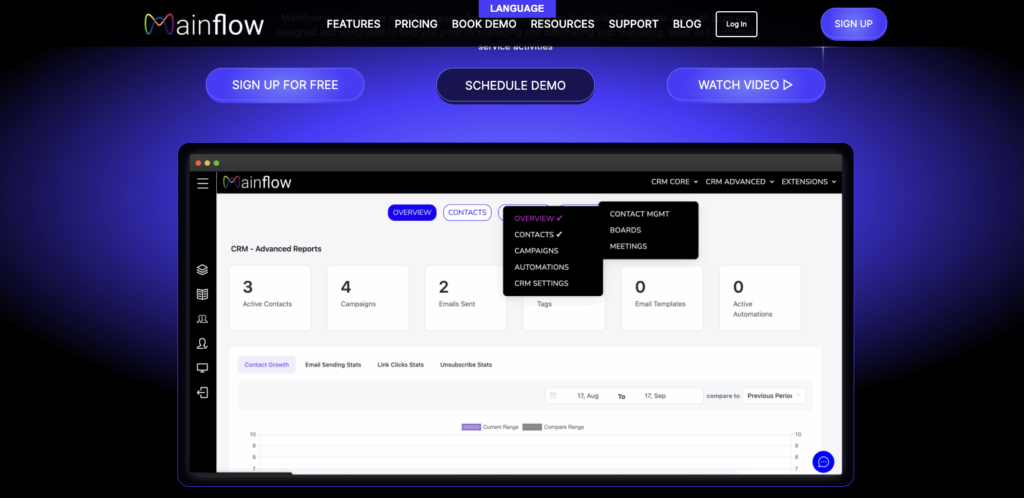
Based on the above I built the predecessor to mainflow.io, back then named automait.it. The value proposition was a business process automation platform for companies, all drag and drop. It went on market back in 2020 and we managed to get in a couple of customers. But sales was slow and hard. Mostly because Automait was a small company, offering services that mostly large companies would need and have the resources to implement. So, I decided to go another route, and utilize the plugins already on the platform but change the value proposition around completely. From focusing on corporate optimization through business process automation (a hard sell, and relatively few customers) to focusing on software to help micro and small businesses attract and gain new customers (90+ % of all companies). Along the way, the name and branding changed from automait to mainflow. This is what mainflow.io looks like today:
The homepage
mainflow.io
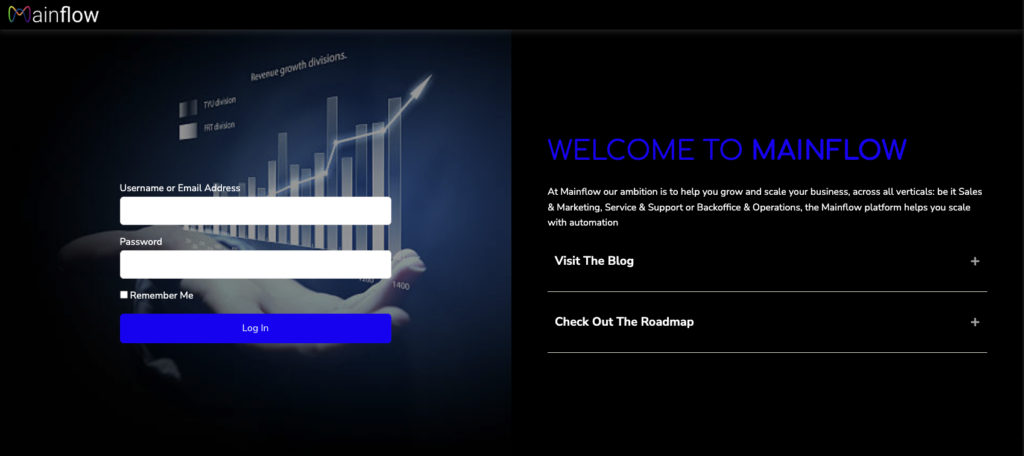
Login Page
app.mainflow.io
Logged in
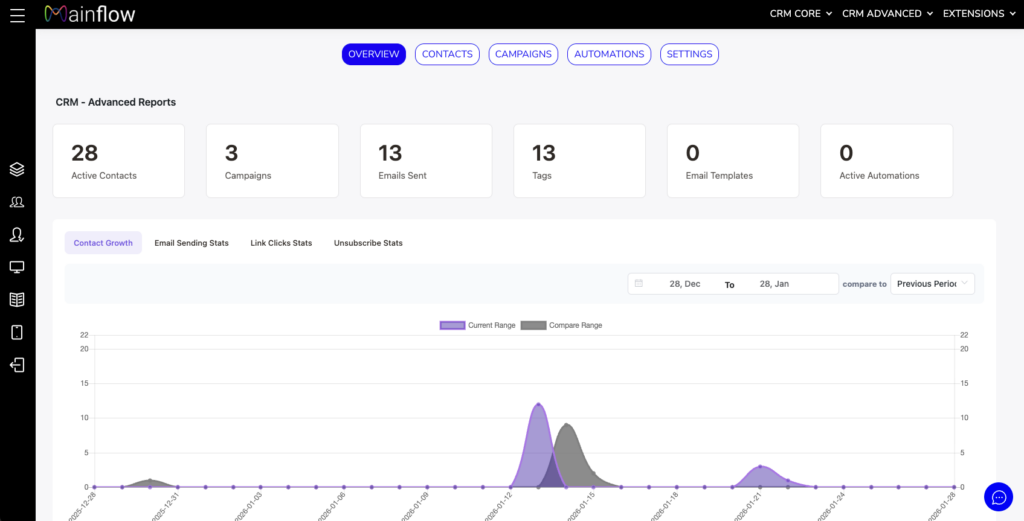
Mainflow CRM
Today, in 2026, Mainflow CRM is a fully-fledged CRM platform. We have 10 different apps that are all sourced and curated to help micro and small businesses grow and scale. So the focus of Mainflow is to support all commercial and customer oriented activities. All apps are designed and integrated to help you grow by managing and automating your marketing, sales and customer service activities. What our customers mostly look for is the CRM part, that is, contact management, segmentation, email marketing automation, sales pipelines and task management.
The apps on the Mainflow platform are: Contact Management & Email marketing / Sales Pipelines & Boards / Online meeting Booking / Social Media Auto-publishing / Customer Portals & Community / Support Tickets / Landing Pages / Analytics / Opt-in Forms / E-signature.
As you can hopefully sense, we have apps to support a 360 customer lifecycle, from generating leds, to acquiring new customers and to serve existing customers. And the best part – many of these activities can be automated to repeat this proces again and again. Essentially creating a flywheel effect to grow and scale.
We have customers from around the world, from the US to Turkey and to several other European countries. Most of them use several of our apps but a few have migrated just to use one app. For example one of our customers used to use Podio for knowledge sharing, but are now using Mainflow Portals for the same. With our pricing model and price point, they save a lot of money and get access to many more features, if needed.
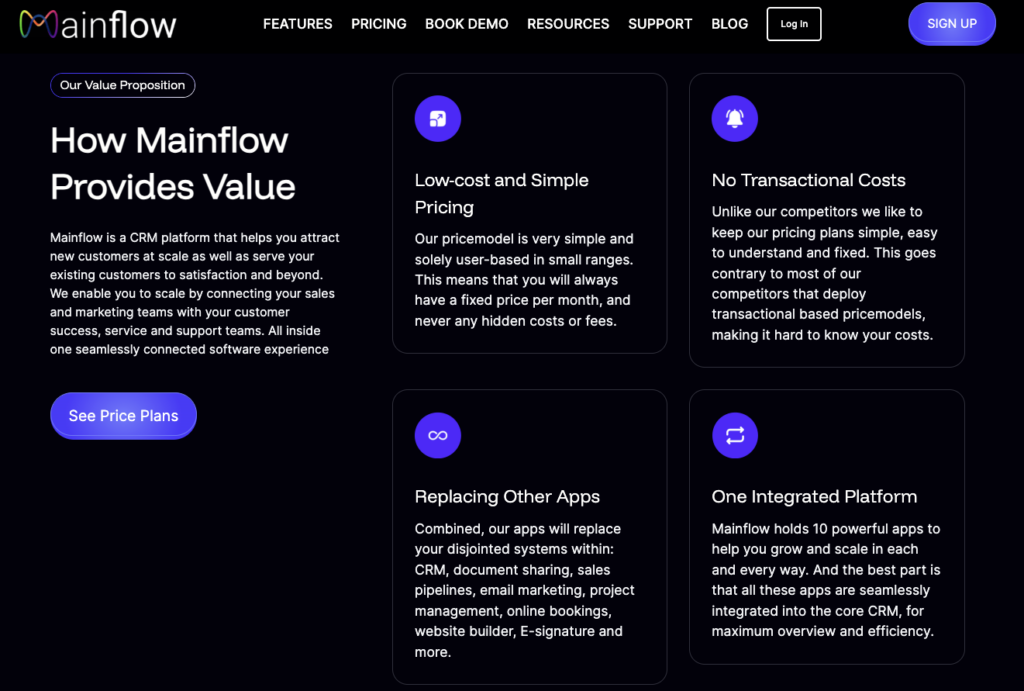
The Mainflow Value Proposition
Thoughts on building a SaaS on WordPress
Having built a SaaS on WordPress, I’ve of course given it many thoughts over the years, also in relation to doing it on an alternative platform such as Microsoft Azure or Google Cloud. Some of the key differences and advantages doing it on WordPress are: The fact that WordPress is open source and therefore has so much functionality, both free and paid, that you can utilize for your SaaS. Moreover, if you would like to tweak the functionality of he plugins you’ve chosen for your SaaS, many times the plugin developer will help you, and if not, you can easily get an external developer to help you – because it’s standardized and open source.
Security and performance is of course a key part of delivering any software as a service. But this has more to do with the hosting provider you engage with than the plugins you choose to use. Of course there are bad developers out there that don’t develop plugins or themes by the standards and that might negatively impact your security or performance, or both. However, this is easily solved by: looking for good plugin developers and companies, by checking the plugin code before putting it into production, and by having a top-notch hosting provider that takes good care of security and performance for their customers.
With the above mentioned plugins at the core, it is actually possible for anyone to build an actual software as a service application and business, and take it to the market. One thing to mention though: It will take a lot of time and effort, and you will likely run into doing many customizations along the way that you have to do yourself, or pay someone to do. But the foundation using WordPress, Ultimate Multisite, WPFrontendAdmin and the plugins of your choice for your niche, is just sitting and waiting for you to get started.
Leave a Reply